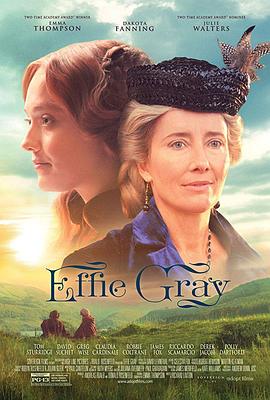
John Ruskin是英国维多利亚时代的艺术家、诗人、建筑师、思想家,还扶持培养了一批年轻艺术家,不过成为社会新闻的却是他与Effie Gray的婚姻,两人结婚6年之后Effie要求中止婚姻,理由是两人“从未真正成为夫妻”,这桩官司成为一时谈资。John Ruskin承认两人从没上过床,但为自己辩护说妻子的“某种状况”破坏了他的激情。Effie Gray离婚后,嫁给了受John Ruskin重视提拔的画家John Everett Millais。据艾玛·汤普森说,这部新片将从两人的新婚之夜开始,通过John Ruskin的经历和性格来解开这个谜团。 2011.08.17.达科塔取代西尔莎成为《Effie》女主角. Dakota Fanning replacing Saoirse Ronan in Emma Thompson's 'Effie' August 16 Source Deadline Just last November, one Casting Tidbits update revealed The Lovely Bones star Saoirse Ronan landed the title role in Effie, a biopic about Effie Gray, the wife of English art critic John Ruskin, who became entangled in a famous Victorian love triangle. Now Deadline reports Dakota Fanning will star in the period drama from writeractresa Thompson which chronicles the strange romance, or lack thereof, between Gray and Ruskin. Despite her beauty, Ruskin was said to be disgusted with Gray's body, did not consummate the marriage and annulled it, allowing her to marry Ruskin's protégé John Everett Millais.Though Orlando Bloom was once attached to play Millais, apparently Tom Sturridge (Pirate Radio) has stepped into the role. In addition, Thompson will also star in the film as Lady Eastlake, who takes Effie under her wing when it becomes clear the union was destroying the young woman. Her husbandGreg Wise (Johnny English) will play Ruskin while Julie Walters (Harry Potter franchise) and Derek Jacobi (The King's Speech) will play his parents. Finally, Edward Fox (Gandhi) is in talks to play Eastlake's husband Sir Charles a man who was not only fed up with Ruskin and his radical ideas, but also the main patron of the Royal Academy which held sway over what constituted fine art. Richard Laxton (An Englishman in New York) is directing the film which begins shooting in Scotland on October 17th with shooting to follow in London and Venice as well. The cast has been shuffled on this project for awhile with Carey Mulligan once attached to the title role as well, but a copyright infringement claim held up the film, which resulted in scheduling conflicts for the previously attached cast members. Producer Don Rosenfeld says, It’a Thompson’s first original script after doing several fine adaptations, and it gets to the heart of Victorian England. Though this sounds a bit more along the lines of her work on Sense and Sensibility as opposed to Nanny McPhee, her work on the page should make for a great British drama down the road.
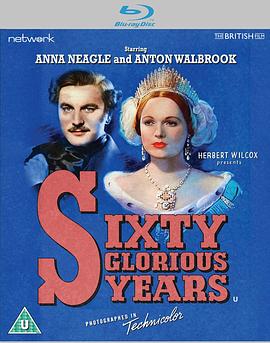
Sixty Glorious Years is an exercise in the creation of iconography, both for Victoria and its star, Anna Neagle (who subsequently became known as 'Regal Neagle'). Just as Elizabeth I commissioned artists to create flattering iconic images for public consumption, so this film performs a similar function, for Neagle is more beautiful than the real life Victoria. Controversial events (such as the 'Irish problem') are omitted and unpleasant aspects of Victoria's character (her petulance, arrogance, favouritism and 'right to privilege') are glossed over as endearing little 'whims'. Albert acts as a moderating influence when she goes too far. The film followed a year after the highly successful Victoria the Great (d. Herbert Wilcox, 1937). Again the screenplay is by Miles Malleson and Robert Vansittart, and many of the supporting cast (the cream of acting talent of period) repeat their roles, this time for the colour cameras. This was the first full length Technicolor film of cinematographer Freddie Young, who captures the spectacle of royal weddings, grand balls and opulent interiors, with scenes actually filmed at royal palaces. Vivid battle scenes, set in Alexander Korda's empire territory (Sevastopol and the Sudan), rival those in The Four Feathers (d. Zoltan Korda 1939). The title music sets the tone a regal choir sings over a shot of the crown. Elgar's 1901 'Pomp and Circumstance' march is heard during the diamond jubilee celebrations and, as Victoria's coffin lies in state, the film concludes with Anthony Collins' stately music accompanied by the text of Rudyard Kipling's 'Lest we forget'. Combined with the emotional appeal of scenes of Victoria connecting with her 'ordinary folk', this is stirring stuff. The film connects with contemporary events of 1938. The release of two celebratory royal films was intended to boost public affection for the monarchy in the wake of Edward VIII's abdication. Anglo-German relations were another touchy subject. With another war on the horizon, influential voices wanted appeasement, and the film could be seen to fit that agenda. Victoria herself was of mainly German descent, nicknamed 'the grandmother of Europe', while Albert is a 'good German', charmingly played by Anton Walbrook as a cultured, decent man. Sixty Glorious Years now seems unduly formal and reverential. Had movies existed during Victoria's reign (they only emerged at the end) this might have been the kind of film produced. Unlike Mrs Brown (d. John Madden, 1997), it is all so very 'Victorian'. Roger Philip Mellor